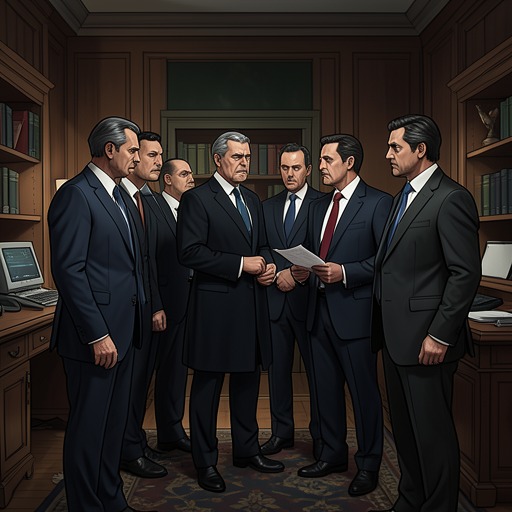
Town merchants
The Government InspectorThe Town merchants are the play’s collective witnesses to the Governor’s abuse of local power: their account turns official corruption from a general suspicion into a list of specific injuries, while the Governor’s response shows how little protection a complaint offers. First feared as a source of denunciation, they approach Khlestakov with a petition and goods, then confront the Governor’s rage when they return. Their movement between those scenes makes them a measure of the gap between the town’s polished claims of good administration and the coercion that sustains it.
Identity and Place in the Town
The merchants appear not as individually developed characters but as a group subject to the Governor’s authority. Their collective role matters: they represent people whose livelihoods and property can be reached directly by a local official, yet whose complaint must be carried to a visitor they believe may have power to intervene. In the petition scene, one merchant gives the group’s account, while the stage direction presents Khlestakov receiving the merchants together.
Their first appearance is announced from outside. After giving a letter to Osip to be mailed, Khlestakov hears the merchants insist that they have business and cannot simply be kept out. When they enter, they bring a basket of wine and sugar loaves. The objects establish the encounter as both a request for access and a formal presentation of goods; the play does not state that the basket is a bribe or specify what the merchants expect in exchange. Their own account, however, makes clear that they are there to complain about the Governor.
A Threat the Governor Anticipates
Before the merchants confront Khlestakov, Anton Antonovich Skvoznik-Dmukhanovsky admits that the merchants and townspeople trouble him because he believes he is unpopular with them. He wonders whether he has been denounced and asks the postmaster to open letters passing through the office, read them for information against him, and either reseal or deliver them opened. The merchants’ power in this moment is not formal authority but the possibility that their account of his conduct may reach someone above him. His attempt to monitor correspondence shows how he responds to that risk: not by correcting his administration, but by seeking control over what can be reported.
The anticipated inspection also produces a performance of compliance. The Governor orders officials to say that they are perfectly satisfied if questioned, and threatens consequences for anyone who is not. Elsewhere, he presents the town to Khlestakov as a place whose officials think only of winning the government’s esteem through order, vigilance, and efficiency. Against these claims, the merchants’ later testimony supplies a view of what official self-presentation excludes. The inspector’s arrival, especially the Governor’s belief that it may bring scrutiny of his district, heightens the contrast between the approved report and the complaints he fears.
The Merchants’ Complaint
In their account to Khlestakov, the merchants say the Governor has taken the bread out of their mouths by quartering soldiers on them. They describe the burden as severe enough to threaten their livelihoods. Their complaint is therefore not limited to an official’s discourtesy: it identifies the practical cost of his demands on the people who must house and provision those placed under his authority.
They also recount personal humiliation. The Governor, they say, grabs a merchant by the beard and calls him a Tartar. The merchants insist that they have obeyed the laws and regulations, and distinguish what they have already supplied for the Governor’s household from the additional exactions. They say they do not object to providing what his wife and daughter need for their clothing, but that this has not satisfied him. According to their representative, the Governor enters a shop, selects whatever catches his eye, and orders the goods taken to his house. The example is specific: a piece of cloth that the merchant estimates at almost forty yards. The sequence—from forced accommodation of soldiers, to insult, to demands on household goods—shows how the complaint joins economic loss to the indignity of being unable to refuse.
Khlestakov reacts by calling the Governor a swindler. The response gives the merchants a hearing, but the play offers no evidence that it produces an investigation or restitution. Their testimony exposes the conduct to someone they take for an inspector; it does not, by itself, change the balance of power in the town.
Complaint and Retaliation
The merchants appear again after Anton Antonovich has imagined that his association with Khlestakov may help him rise in rank, even to a generalship. The stage direction identifies the following scene as involving the same company and the merchants. The Governor greets them with the language of a welcoming father, then immediately accuses them of having complained against him. His apparent warmth collapses into abuse: he calls them cheats and pirates, asks whether they expected to land him in prison, and invokes curses against them.
This confrontation turns the earlier petition into an occasion for retaliation rather than redress. The Governor does not answer the allegations about soldiers, insults, or cloth; he treats the act of complaining itself as an offense against him. Anna rebukes him for his language, but the merchants’ vulnerability is not resolved in the available scene. The contrast between his imagined promotion and his attack on the complainants is pointed: the prospect of higher standing has not made him more accountable to the people he governs.
Narrative and Social Significance
The merchants make corruption legible through ordinary transactions and concrete losses. A request to house soldiers, a garment taken from a shop, and a complaint about goods for the Governor’s family show how official power enters commercial life. The play sets this testimony against administrative claims of order and against the Governor’s effort to ensure that no official reports dissatisfaction. The merchants thus reveal the machinery behind the reassuring public face: information is managed, obedience is demanded, and the people who report abuse can be met with threats.
The introductory discussion of the play frames its satire as reaching beyond individual misconduct to the system that breeds and protects it, even while noting Gogol’s emphasis on the moral exposure of individual characters. The merchants’ scenes make that tension tangible. Their accusation names one Governor’s actions, but his control over their goods, their access to officials, and their freedom to complain gives those actions institutional force. Their role is brief, yet their testimony supplies one of the play’s clearest contrasts between official authority as it describes itself and authority as the townspeople experience it.